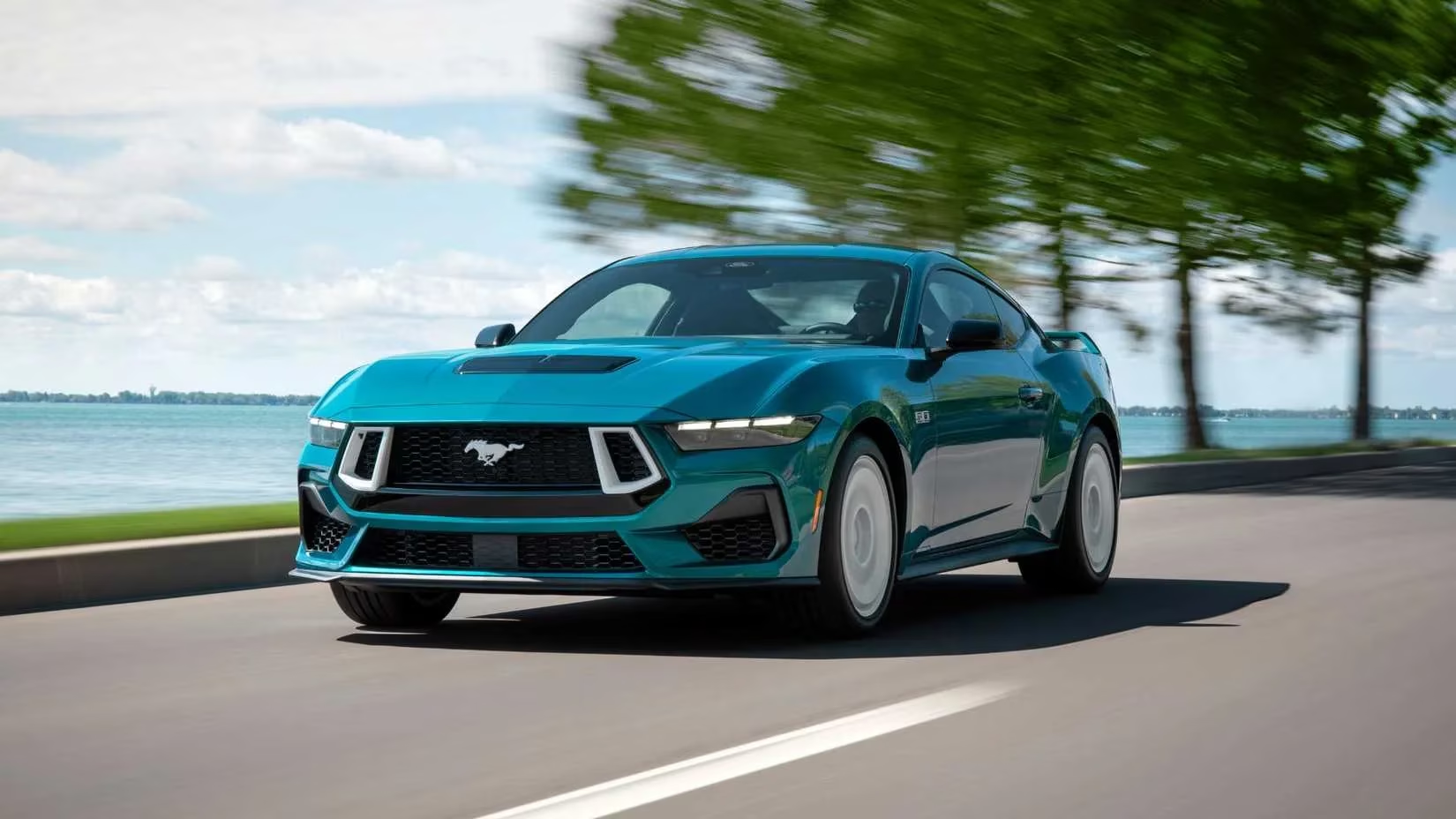
Ford recall 2026, safety recall targets Mustang, Maverick, Explorer, and Lincoln Corsair for engine oil leak risk, ensuring proactive consumer protection.
A manufacturing defect, as silent and potentially devastating as a slow-burning fuse, has been identified and contained before it could reach consumers. In a move demonstrating proactive quality control, Ford Motor Company has issued a crucial safety recall for select 2026 model year vehicles. The action targets certain Ford Mustang, Maverick, Explorer, and Lincoln Corsair models equipped with 2.0-liter and 2.3-liter EcoBoost four-cylinder engines. The identified issue involves a critical component omission during engine assembly that could lead to catastrophic oil leaks, posing risks of engine failure or, in worst-case scenarios, under-hood fires. The silver lining in this situation is as clear as a factory-fresh windshield: all affected vehicles were intercepted while still in dealer inventory, ensuring no customer-owned vehicles are impacted.

The Root of the Problem: A Missing Piece
The recall process was initiated following a discovery at Ford's Chicago Assembly Plant on November 13, 2025. During a routine quality check, technicians encountered a 2026 Ford Explorer exhibiting an engine oil leak. The investigation that followed pinpointed the cause to a missing ball plug on the intake face of the cylinder head. This tiny component, crucial for sealing an oil passage, was absent. Delving deeper, Ford's engineering team uncovered a troubling procedural lapse. The problematic cylinder head had initially been rejected for failing a low-pressure test during the ball plug installation phase. However, it was erroneously reintroduced into the production line without the necessary corrective action—like a flawed puzzle piece being forced into place, compromising the integrity of the whole assembly. A subsequent audit revealed more engines had been fitted with cylinder heads sharing this same critical defect.

The Serious Implications of an Oil Leak
An engine oil leak is far from a minor inconvenience. Engine oil serves as the lifeblood of an internal combustion engine, performing several vital functions:
-
Lubrication: Reducing friction between moving metal parts.
-
Cooling: Carrying heat away from the combustion chamber.
-
Cleaning: Suspending contaminants and sludge.
-
Sealing: Helping piston rings seal against cylinder walls.
Without adequate oil pressure and volume, an engine can suffer rapid and catastrophic damage. In the specific case identified by Ford, the leaking oil from the unsealed passage could lead to a severe drop in oil pressure, resulting in engine seizure. More alarmingly, if the leaking oil comes into contact with hot engine components—such as the exhaust manifold or turbocharger—it can ignite, leading to an engine compartment fire. This dual threat of mechanical failure and thermal incident elevated the issue to a critical safety priority.
The Extensive Recall and Complex Fix
Officially filed with the National Highway Traffic Safety Administration (NHTSA) on December 1, 2025, the recall mandates immediate action. Ford has directed its dealership network to perform repairs at no cost to any future owner. The scope of the fix underscores the severity of the manufacturing error. It is not a simple case of installing the forgotten ball plug. Due to the potential for damage during the initial faulty assembly and the precision required for the repair, Ford's prescribed corrective action is the complete replacement of the entire cylinder head assembly on every affected engine. This is a significant and costly procedure, but it is the only way to guarantee the long-term reliability and safety of the powertrain.
| Affected 2026 Models | Engine | Core Issue | Remedy |
|---|---|---|---|
| Ford Mustang (EcoBoost) | 2.3L EcoBoost I4 | Missing cylinder head ball plug | Replace cylinder head assembly |
| Ford Maverick | 2.0L EcoBoost I4 | Missing cylinder head ball plug | Replace cylinder head assembly |
| Ford Explorer | 2.3L EcoBoost I4 | Missing cylinder head ball plug | Replace cylinder head assembly |
| Lincoln Corsair | 2.0L EcoBoost I4 | Missing cylinder head ball plug | Replace cylinder head assembly |
A Best-Case Scenario in a Recall Situation
While the defect itself is serious, the outcome represents a best-case scenario for both Ford and its customers. The containment of the issue is as complete as a perfectly sealed container. Key positive aspects include:
-
Zero Consumer Impact: No vehicles with this defect were sold to retail customers. All were identified and quarantined on dealer lots or at the factory.
-
Proactive Discovery: The defect was caught internally through Ford's quality assurance processes before any reports from the field.
-
No Reported Incidents: Ford has confirmed it is not aware of any accidents, injuries, or fires related to this condition.
-
Clear Communication: The recall was publicly announced and registered with the NHTSA, ensuring transparency.
This preemptive action prevents what could have been a public relations nightmare and, more importantly, a safety hazard for owners. It serves as a robust example of modern manufacturing quality control systems functioning effectively to intercept flaws.
Guidance for Potential Buyers 😊
For consumers considering the purchase of a new 2026 Ford Mustang, Maverick, Explorer, or Lincoln Corsair with the specified EcoBoost engines, this recall should not be a cause for alarm but rather a point of verification. The process moving forward is straightforward:
-
Any affected vehicle on a dealer lot must undergo the cylinder head replacement repair before it can be legally sold or delivered.
-
Prospective buyers should simply confirm with the dealer that all open recalls, specifically recall number 25S45 (example), have been completed on the vehicle they intend to purchase.
-
The vehicle's history will be updated in Ford's and the NHTSA's databases once the repair is performed.

Conclusion: Diligence Over Disaster
The 2026 Ford EcoBoost engine recall highlights the immense complexity of modern automotive manufacturing, where a single omitted component no larger than a pea can have repercussions as widespread as a dropped stone causing ripples across a pond. Ford's swift and comprehensive response—a wholesale replacement of major engine components—demonstrates a commitment to safety and quality, even at substantial cost. For the automotive industry and consumers alike, this event reinforces the critical importance of rigorous quality checks and transparent recall processes. While the term 'recall' often carries negative connotations, this instance stands as a testament to a system working precisely as intended: identifying a problem and solving it before it reaches the road, ensuring that the driving experience remains safe and reliable.